Friday, 12 June 2020

Two Bridges

Royal Military Canal - overcast, mild, se 3 - We decided it was high time for a change of scene, so drove the back lanes across the Marsh to the Dowels where the flatlands abut the Low Weald and the impact of modern agriculture is less intense. We walked our favourite section of the Royal Military Canal between the two bridges of Kennardington and Warehorne. The north side is probably of more interest to the naturalist with a riot of riparian bankside habitat beside the cut and in a smaller secondary ditch (good for damselflies and Marsh Frogs), plus mature ash trees with marginal hawthorn and sallow scrub and views across the distant woodland canopy of the Orlestone forest. The southern bank is more open overlooking rough grazing, broad hawthorn hedges (Turtle Doves and Yellowhammers), patches of marsh and vistas along the bend in the canal.
  Despite the breezy weather Turtle Doves were in good voice with four different birds `purring` from thickets throughout the walk, alongside the same number of singing Yellowhammers, both species I rarely encounter down on the coast. Along the canal a pair of Grey Wagtails were feeding fledged young underneath the railway bridge and a Kingfisher zipped towards Hamstreet from Warehorne bridge. We also noted a decent variety of wayside birds including: a Cuckoo, several Stock Doves, singing Blackcaps, Chiffchaffs, Cetti`s and Reed Warblers, Skylark, Meadow Pipit, Whitethroat, Pied Wagtail, Song and Mistle Thrush, Treecreeper, Long-tailed Tit, Bullfinch, Linnet, Goldfinch, Greenfinch and Reed Bunting. Elsewhere across the Marsh a few Yellow Wagtails, Corn Buntings present in the usual spot near Lydd, while raptors seen through the morning included Hobby, Buzzard, Marsh Harrier and Kestrel.


                                Kennardington section looking north

     
                                Halfway sluice

                                Warehorne church

                                Royal Military Canal

                                Pied Wagtail, Warehorne


  This afternoon a check of the Patch revealed about 50 Common Terns on the beach and over the boil (one of which was a 1st year bird) and two Mediterranean Gulls amongst 100 large gulls, but there was no sign of this morning Roseate Tern. Several passing Sandwich Terns were the first I`ve encountered for a while.

Thursday, 11 June 2020

Book of Hope

Lade - mild, cloudy, ne 2 - A muggy, overcast sort of a morning with hazy visibility and occasional drizzle following on from yesterday evenings welcome rain. The moth trap was a little better last night with 11 species of macros and the first Uncertains of the season, but still low on numbers.
  There wasn't much change on the local patch either apart from many more fledglings out and about including Green Woodpeckers from a nesting hole in the willow swamp. Reed Bunting, Whitethroat, Reed and Sedge Warbler youngsters were all noted around the ponds.
  A couple of visits this week to Dengemarsh resulted in protracted flight views of a Bittern returning to the Hookers reedbed and a `booming` male. Several each of Marsh Harriers, Buzzards and Hobbies noted, plus Reed and Sedge Warblers, Whitethroat, Yellow Wagtail, Corn Bunting, Bearded Tit, Raven, Redshank, Lapwing and Oystercatcher all showing evidence of having bred successfully.


                                Moorhen, Lade

Wilding by Isabella Tree (Picador, 2018) - I read Wilding in two sittings; and then a week later, read it again! It was simply wonderful, and so inspiring (thanks for the loan DB). Back in 2000 Isabella Tree and her husband Charlie Burrell were fed up with fighting a losing battle trying to make a profit from farming 3,500 acres of heavy Wealden clay on the Knepp Estate in West Sussex, so they decided on a radical change of direction and set about restoring their farmland to nature.
  Now, if that sounds simple, it isn't, as testified by the trials and tribulations told by Isabella in her highly readable book packed with fascinating facts and figures, some of which were completely new to me. For example, the concept that much of lowland Europe, including Britain, may once have been open wood pasture created by vast herds of wild, grazing animals such as bison, aurochs, tarpans and deer, was quite mind-blowing, and it was only when Homo sapiens came on the scene and pretty much wiped them out that closed canopy woodland dominated the landscape.
  As a result of this theory modern day grazing animals (Exmoor ponies, Old English Longhorn cattle  and Tamworth pigs) replicate the pre-Neolithic animals and are key to the re-wilding project and resulting terrain, where rare and declining beasts such as Nightingales and Purple Emperors have quickly colonised in considerable numbers, often in atypical habitat. There are many other surprises from the Knepp re-wilding experiment which must have given traditional conservation organisations pause for thought and, maybe, rethink some of their strategies.
  But above all this is a book of hope for the future of our much depleted planet, and an example of what can be achieved on marginal land elsewhere, if only other like-minded landowners would take up the batten from the Knepp Estate.


Monday, 8 June 2020

Rosy Starling

Lade - cool, cloudy, drizzle, N3 - A grim morning for our tour of the local patch accompanied by a fine drizzle and a nippy wind out of the north. Swifts were once again the order of the day with hundreds swooping low over the still waters, where a small flock of Pochards on south lake hinted at the changing season. More Swifts streamed across the Desert where the Starling flocks had returned to the sodden turf to hunt leatherjackets following yesterday evenings downpour (11mm recorded at the KRC).


                               Rosy Starling,  Lydd

  News came through late morning concerning the reappearance of the Dengemarsh adult Rosy Starling that had relocated to The Rype at Lydd. By the time I arrived it was absent, but soon reappeared on the `village green` to feed amongst its commoner congeners and tug invertebrates from the burnished turf. By now a small gathering of local birders had arrived, some of whom I`d not seen since lockdown, to enjoy this cracking migrant from the east which has been turning up across the country in some numbers.

Sunday, 7 June 2020

Starlings

Lade - cool, dry, sunshine and cloud, w 3 - A weekend of mixed weather with cool conditions for June and a couple of hefty showers yesterday (well, at least 3mm!) along with strong winds. Today was more benign with the wind easing and more rain in the evening.
  On the local patch not much change with hundreds of Swifts coming and going over the lakes and on Saturday afternoon along the foreshore and in off the bay. There are few waders on the bay now with a typical count comprising up to 100 Oystercatchers, 30 Curlews and small numbers of Ringed Plovers and Bar-tailed Godwits. Chatting to DS yesterday on the beach, he too confirmed the absence of Sandwich Terns this spring where normally hundreds gather at low tide out on the sands to roost, preen and pair-bond. I understand that the colony at Rye Harbour never got going this year and soon cleared out, perhaps, due to a shortage of food.
  More Coots, Dabchicks and Mallards were on the lakes with their offspring which in turn has seen an increase in patrolling Marsh Harriers. The two Oystercatcher chicks are still extant on the scaffold island and I suspect that the Egyptian Goose pair may have goslings nearby judging from their reaction when a Herring Gull landed nearby and received the full treatment!

                                Egyptian Goose, Lade


  Its been a week now since I`ve heard or seen a Cuckoo at Lade and I suspect the male didn`t attract a mate and has either moved on or, more likely, cleared off back south to Africa. A flock of at least 32 Long-tailed Tits around the ponds was a classic post-breeding gathering.
  At home the moth trap has been idle due to the cold, windy nights, but there has been much entertainment from our local Starlings and their new born enjoying the relative sanctuary of the back garden. However, there`s always one or two on raptor lookout and more than once today the distinctive alarm call alerted the flock to an incoming Sparrowhawk.


                               Starlings, Plover`s garden

  Spent the afternoon birding around Dengemarsh, Galloways and the Ranges looking for Starling flocks, one of which hosted an adult Rosy Starling yesterday, of which there was no sign; infact hardly any Starlings were present on the sheep folds, just plenty of corvids and Woodpigeons. Several Marsh Harriers, Buzzards and Kestrels noted across the area, plus a Little Owl by the watch tower, two singing Corn Buntings and Yellow Wagtails from Springfield Bridge, three Hobbies and a `booming` Bittern at Hookers, several Cuckoos, Little Egrets, Common Terns, Bearded Tits, Shovelers, Lapwings, Redshanks and a Raven elsewhere.
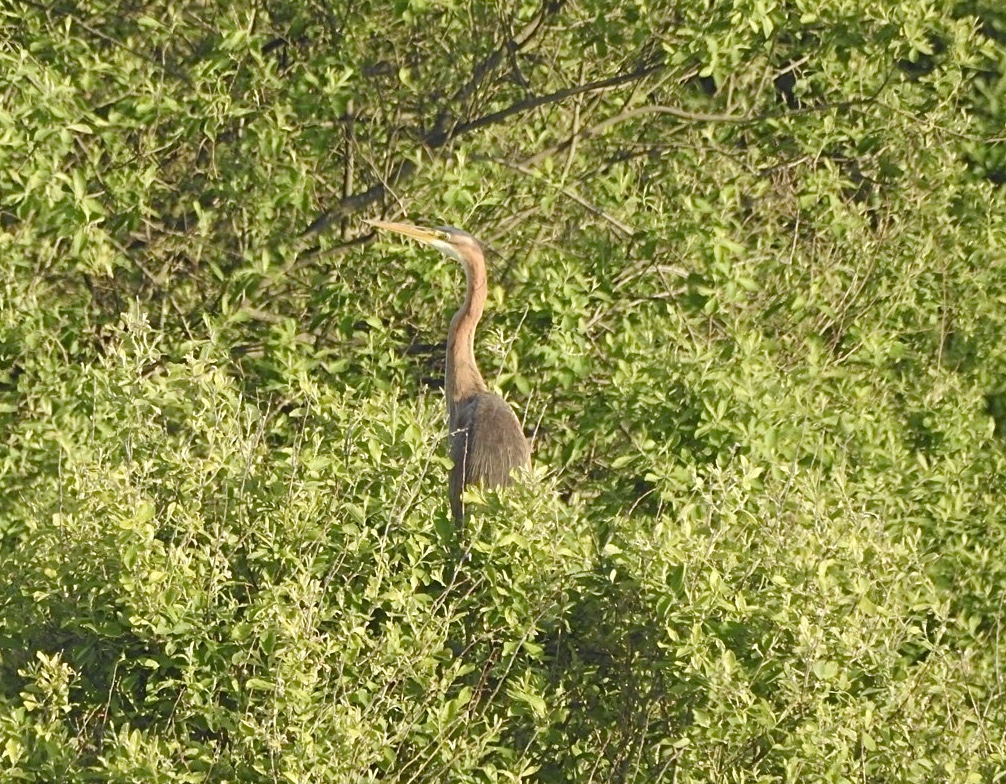
  David Scott has been busy with the camera and kindly forwarded on the best of his pics from last months outings around Dengemarsh (below). The wagtail pic is interesting: a spring male Flava type showing the hybrid qualities of a Yellow x Blue-headed Wagtail, known colloquially as `Channel Wagtail` and exhibiting a pale-blue head, white supercilium, throat and bib.


                                Purple Heron (by D Scott)

                                Glossy Ibis (by D Scott)


Putative `Channel Wagtail`  Motacilla flava x flavissima (by D Scott)


Friday, 5 June 2020

Swifts

Lade  - cool, dry and cloudy, nw 4 - Since my last post two days ago there has been a perceptible shift in the weather with a low pressure system out in the North Sea delivering cooler temperatures, stronger winds and bands of showers to some parts of the region which, so far, have mostly eluded us here on the coast.
  As expected in such weather patterns in June, rain-dodging Swifts have occurred in large numbers hawking insects over the still waters across the Dungeness peninsula. This morning we counted at least 200 over Lade pits, while a visit to the bird reserve around noon, from public footpaths and viewpoints, produced `hundreds` more. I could watch Swifts all day long, although trying to photograph them using a bridge camera is `challenging` to say the least!

                                Swift over Lade south

  Scanning from the east side of Burrowes it was good to see plenty of Common Tern activity on the rafts, which are still covered in willow brush placed there over winter to deter the Herring Gulls. However, the terns appear to be benefitting from the brush cover with at least 30 pairs nesting on the raft in front of Dennis`s hide along with four or five pairs of Black-headed Gulls. More terns were present on the raft opposite the visitor centre and over the road on ARC making for a total of around  100 pairs across the site.
  Moving onto waders, the following were counted on the islands: 15 Curlews, four Bar-tailed Godwits, four Knots (one in summer plum), four Lapwings, two Dunlins and a Turnstone. On the walk across to the causeway a pair of Oystercatchers and a Lapwing with two well grown juvs each were noted, plus two Cuckoos, Hobby, Marsh Harrier, Lesser and Common Whitethroats, Cetti`s   and Reed Warblers.
  Back at Boulderwall, a conversation with RSPB staff confirmed that the Dungeness reserve will remain closed to visitors until further notice.

                                Common Tern breeding activity

Wednesday, 3 June 2020

Dungeness at last!

Lade - warm, dry, overcast, light airs - With muggy, still overnight weather conditions perfect for moth activity, it was no surprise to see the garden trap well loaded this morning when I threw the towel over it just after 4.30am. Of the 23 species of macros eight were new for the year including, two Privet Hawk-moths, Common Wainscott and Common Marbled Carpet, the latter a moth I rarely catch.


                               Common Marbled Carpet


                               Privet Hawk-moth


  The past couple of mornings outback have been a bit samey with just the breeding Little and Great Crested Grebes, Coot and Mallard on the water showing off their young. A pair of Common Terns went over calling yesterday along with a Redshank and four Mediterranean Gulls likewise. A Sparrowhawk took one of the juv Starlings from a flock foraging on the shingle ridges and a Green Woodpecker showed for the first time in ages, otherwise all was quiet on the bird front.

                               Mallard with nine ducklings

  However, wandering along the main track searching for orchids and lamenting the lack of butterflies in general we came across a freshly emerged Marbled White, one of my favourites and a week or so earlier than is normal. It sat amongst a riot of colourful, scorched plants, basking in the weak sunshine and affording superb views, as well as conjuring up one of those special moments that you get from time to time in nature, especially when you consider the various stages of transformation that it has had to go through to reach the final imago. Its always best to enjoy Marbled White`s while they`re on the wing as they only have a single brood with a short two month flight period during high summer.


                                First Marbled White of summer

This afternoon after a hiatus of some ten weeks due to lockdown we paid our first visit to the Dungeness Estate. Mercifully, the overcrowding of last weekend had relented and there were few people present. Walking down the concrete road towards the fishing boats, Skylark, Meadow Pipit, Linnet and Stonechat were all noted in song, plus a distant Wheatear perched atop an old shed.
  I decided on a seawatch; not something I would normally do in early June with an easterly airflow, but these are far from normal times. Barney found an old bit of wood to chew on and I settled down for an hour scanning the Channel seeing pretty much bugger all apart from several passing Common Terns, Black-headed Gulls and Cormorants and a couple of Porpoises offshore.
  But it mattered not a jot; a seawatch from the boats was another box ticked on the road to normality, whatever that may be in future...


                     "Woof-woof, ten weeks without seawatching - pure bliss, woof-woof!"

Monday, 1 June 2020

May lockdown summary

Lade - warm, dry and sunny, ne 4 - Following the lunacy of the weekend when the beaches were packed out with visitors and the coast road reduced to a single lane due to parked vehicles (mostly kite-surfers), today things returned to some sort of normality.
  Around the local patch a few more ducks such as Gadwall and Pochard were noted on south lake while Dabchick and Coot juvs were out on the water. Also confirmed Oystercatcher breeding this morning with the sighting of a well-grown chick on one of the islands, while two Redshanks and five Mediterranean Gulls flew over calling. Butterfly numbers have been in short supply so far this spring, but along the main track I did notice a few Small Coppers, Small Heaths and Common Blues.

                                Small Copper

  Last month was one of the driest on record down here with only 13mm of rain recorded at Littlestone by OL; no wonder the shingle ridges look burnt to a crisp. Due to the lockdown restrictions certain birds that may have tempted travelling birders went unreported until after the event. Most were typical May overshooting migrants from the south and all moved quickly through the Dungeness peninsula, including: Purple Heron, Glossy Ibis, Spoonbill, Cattle Egret, Honey Buzzard, Black Kite, Montagu`s and Hen Harriers, Whiskered Tern, Pectoral and Curlew Sandpipers, Little Stint, Bee-eater and Serin.